


You can refresh a home for £300–£600 per m², yet a full refurbishment can push past £2,000 per m². In 2025, you’ll feel the impact of higher labour rates, volatile material pricing, tighter regs, and rising insurance, so you can’t rely on rough averages. You’ll need to know what a quote actually includes—VAT, prelims, waste, surveys—and where contingencies belong, because the biggest cost jumps often start before work begins…
Key Takeaways
- Expect broad cost bands: £300–£600/m² refresh, £700–£1,200/m² mid refurb, £1,300–£2,000+/m² full renovation.
- Room benchmarks help budgeting: kitchens £8k–£25k, bathrooms £5k–£15k, rewires £4k–£12k, depending on spec and complexity.
- 2025 prices are pushed up by booked-out trades, stricter compliance, volatile materials, higher transport/storage, and increased finance and insurance overheads.
- Quotes should itemise labour, materials, preliminaries, subcontractors, VAT, and exclusions like design, surveys, building control, and utility connections.
- Plan 10–15% contingency, lock scope and drawings early, track weekly spend, and avoid false economies in waterproofing, insulation, fire safety, electrics, and structure.
2025 UK Renovation Costs: Quick Ranges + £/m²

Although every property starts with different constraints, you can still budget accurately in 2025 by using two anchors: typical UK renovation cost ranges and a £/m² benchmark based on the scope and finish level.
For light refreshes (decor, minor repairs), allow roughly £300–£600/m².
For mid-scope refurbishments (new kitchen/bathroom, partial rewires, joinery), plan £700–£1,200/m².
For full renovations with layout changes and higher-spec finishes, use £1,300–£2,000+/m².
Validate your number against room-based ranges: kitchens £8k–£25k, bathrooms £5k–£15k, rewires £4k–£12k.
Adjust for Design trends that lift specification, and tighten material sourcing early to lock lead times and substitutions.
What’s Included in a UK Renovation Quote (Labour, VAT, Prelims)?
Once you’ve set a £/m² budget and checked it against room-by-room ranges, the next step is making sure your quote actually covers the full cost to deliver the work. A proper UK renovation quote should separate labour, materials, and subcontractor packages, then state VAT status (inclusive/exclusive) and the applicable rate.
Check prelims: site setup, welfare, skips, protection, temporary services, access/scaffold, parking, and programme management. These often sit outside trade rates yet drive totals. Confirm what’s excluded: design fees, building control, party wall, surveys, utility connections, and decorating.
Insist on a written specification that fixes Material quality (brand, grade, finishes) and matches drawings. For Contractor selection, compare like-for-like scopes, insurances, guarantees, and payment stages tied to milestones.
Why UK Renovation Costs Are Rising in 2025
Because you’re buying time, compliance, and scarce capacity—not just bricks and plaster—UK renovation costs keep climbing in 2025. You’ll see higher day rates as qualified trades stay booked out and subcontractors price risk into programmes with tighter lead times and liquidated-damages exposure.
You also pay more for regulatory alignment: Building Regulations updates, fire-stopping evidence, electrical certification, and documented test results all add labour hours and inspection fees.
Material pricing remains volatile, and suppliers pass on transport, storage, and wastage allowances, especially when you need like-for-like matches.
Financing costs lift overheads, so contractors add prelims for site security, welfare, and compliance admin.
Finally, insurers scrutinise hot works and theft risk; stricter home insurance conditions can mandate alarms or permits. Your property valuation depends on documented compliance, not just finish.
UK Renovation Costs 2025 by Project (Kitchen, Bath, Rewire, Windows)

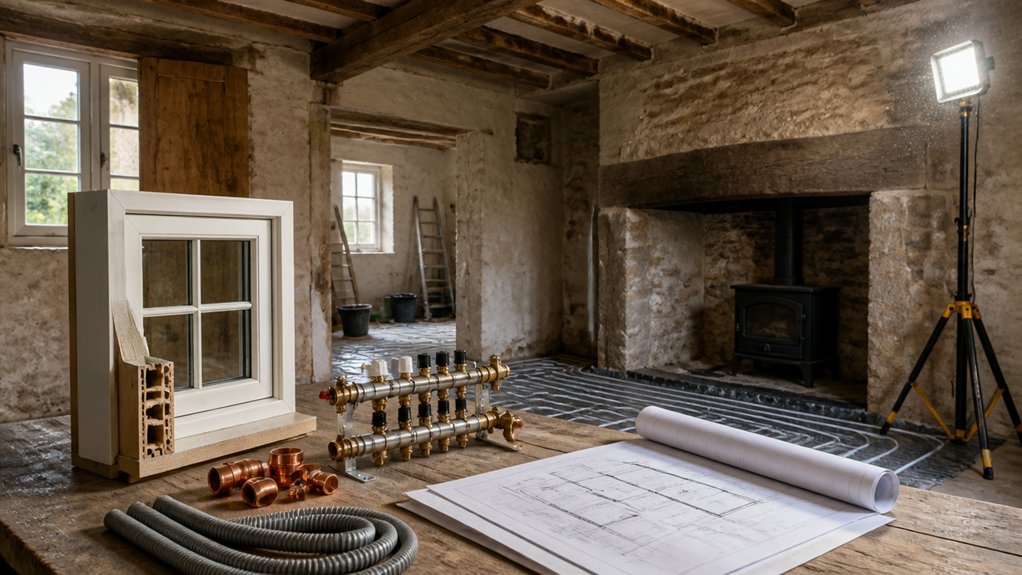
Those same pressures—scarce labour, tighter compliance, and volatile supply chains—show up differently depending on what you’re renovating, so you’ll get more accurate budgets by costing each project type on its own scope and certification requirements.
For a kitchen, price cabinetry, worktops, appliances, and plumbing/electrics separately. Design trends like handleless fronts or stone-look surfaces can lift supply and fitting costs, so balance them against material durability.
For a bathroom, budget for waterproofing, ventilation, sanitaryware, and tile labour. Specify WRAS-approved brassware and moisture-rated electrics.
For a full rewire, cost per circuit and consumer unit, and require BS 7671 compliance with certification on completion.
For windows, quote by opening type and U-values; meet Building Regulations energy targets and confirm installation accreditation.
Hidden UK Renovation Costs (Surveys, Skips, Upgrades, Delays)
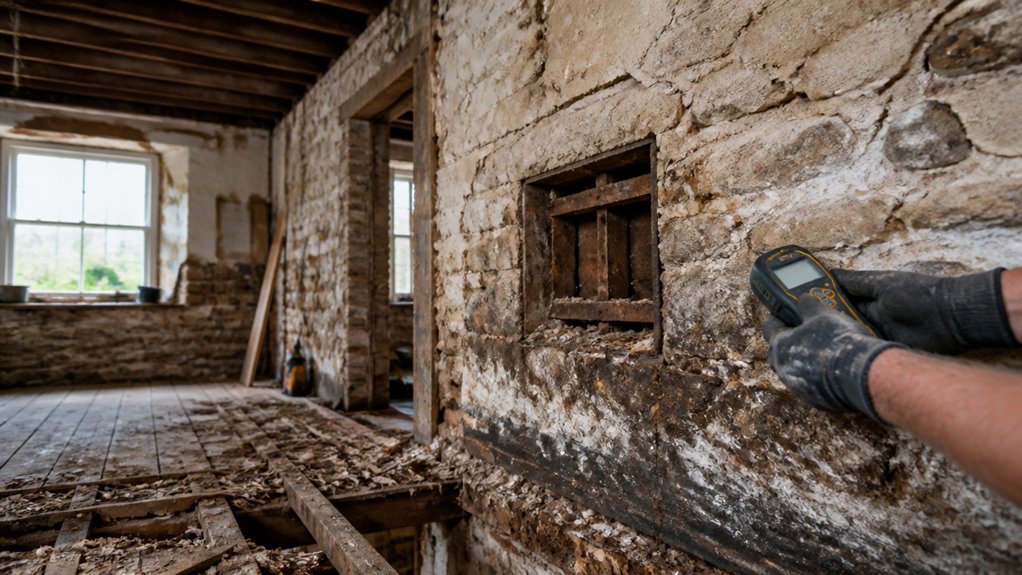
Once you’ve priced the headline works, you still need to budget for survey and testing fees (structural, damp, asbestos, electrics) so you’re meeting lender, insurer, and Building Regulations requirements.
You’ll also pay for waste removal—skip hire, permits, loading restrictions, and extra lifts—often in multiple rounds as the job progresses.
Finally, you should allow for upgrade and delay costs, because uncovering non-compliant wiring, rotten timbers, or supply-chain and trade scheduling slippage can add labour days, variation rates, and re-inspection fees.
Survey And Testing Fees
A proper survey or test can look like a small line item, but it often decides whether your budget stays realistic or collapses under “unforeseen” defects. Price your survey costs early: a RICS Level 2 or Level 3 survey, measured survey, and structural engineer visit each cover different risks, so you can’t assume one report replaces another.
Testing fees add up when you’re opening walls or changing layouts. Budget for asbestos sampling (HSE guidance), damp and timber decay diagnosis, drain CCTV surveys, and electrical condition reports (EICR) before you commit to rewire scopes.
If you’re altering load-bearing elements, include trial holes and material strength checks, and keep written results for Building Control. Spend here to prevent variation claims and delayed redesigns.
Waste Removal And Skips
Where do renovation budgets quietly leak first? Waste removal. Rubble, timber, plasterboard, and soil add up fast, and you’ll pay whether you plan for it or not.
Price skip hire by size and weight limits, not just the headline rate. Check what’s included: delivery, collection, permit fees for parking on a public road, and any “wait time” charges if access is blocked.
Confirm accepted materials; mixed loads, tyres, and some insulation can trigger surcharges or refusal.
For standards-based waste management, ask your contractor for the waste carrier licence number and an itemised disposal allowance in the quote.
If you’re stripping kitchens or bathrooms, schedule more than one skip or a grab lorry to avoid costly overflow bags and extra collections.
Upgrade And Delay Costs
Even if your quote looks watertight, upgrade requests and programme slips can blow it apart faster than any big-ticket item. The usual triggers are “like-for-like” swaps that aren’t: thicker insulation, upgraded glazing, higher-spec sanitaryware, extra sockets, or fire-rated doors to meet Building Regulations. Each change drives labour, lead times, and rework, so you’ll pay variation rates, not tender rates.
Insist on written variation orders, unit prices, and a fixed mark-up before you approve anything.
Delay costs creep in through material shortages and contractor delays, plus slower inspections and late design decisions. Every extra week can mean extended scaffolding hire, welfare, plant, site security, and preliminaries.
Protect yourself with a clear programme, liquidated damages where appropriate, and a contingency allowance for time-related costs.
Contingency + Cost Cuts That Won’t Backfire in 2025
You’ll protect your budget in 2025 by setting a realistic contingency (typically 10–20%) tied to defined risks, firm quotes, and programme allowances.
You can cut costs without compromising compliance by prioritising high-impact choices—standard-size fixtures, simplified layouts, and value-led finishes that still meet Building Regs and manufacturer specs.
You’ll avoid false economies by refusing shortcuts on structure, waterproofing, insulation, and electrics, because failures there trigger rework, delays, and higher whole-life cost.
Smart Contingency Planning
Although your builder’s quote may look “fixed” on day one, UK renovation costs in 2025 rarely stay that way once surveys uncover hidden defects, lead times shift, or Building Regulations trigger extra work.
Build a contingency that’s scoped, not vague: ring-fence 10–15% for light refurbishments and 15–25% for structural, damp, or MEP-heavy jobs, then release it only against approved variations.
Start with a Risk assessment: list cost drivers (asbestos, undersized steels, rot, drainage, party wall conditions, compliance upgrades), rate likelihood/impact, and assign an owner and evidence needed to spend.
Keep Emergency funds separate from contingency, so cashflow doesn’t stall if invoices land early.
Track spend weekly against a cost plan, and freeze design changes after sign-off.
High-Impact Cost Cuts
When you need to pull UK renovation costs back on track in 2025, target the biggest cost drivers first—scope clarity, specification, and programme—rather than stripping out fundamentals that protect compliance and durability. Freeze drawings, issue an inclusions schedule, and lock lead times to reduce variations, prelims, and rework.
Rebalance your contingency: keep 10–15% for unknowns, but release unused allowances only after key inspections and sign-off.
Value-engineer by swapping to readily available sustainable materials with equivalent performance, certification, and fire ratings. Standardise fixtures, rationalise room-by-room finishes, and simplify structural changes before tender.
Protect historical preservation by retaining repairable elements and specifying like-for-like upgrades; it lowers waste, avoids consent delays, and keeps heritage specialists’ labour tightly scoped.
Avoiding False Economies
Before you cut deeper to rein in UK renovation costs in 2025, separate true value-engineering from false economies that simply shift spend into remedials, delays, and compliance risk.
Protect your contingency (typically 10–15% for refurbishments; higher for older stock) and ring-fence it for latent defects, not scope creep.
Don’t downgrade material quality on waterproofing, insulation, fire doors, electrics, or structural elements; failures trigger rework and Building Regulations knock-backs.
Vet contractor reputation with references, insurance, certifications, and a clear programme, then lock scope via drawings, schedules, and change-control.
Price against like-for-like specs, insist on written warranties, and avoid “cash discount” shortcuts that weaken paper trails.
If you cut, cut complexity: simplify layouts, standardise finishes, and phase non-critical upgrades.
Frequently Asked Questions
What Permissions Do I Need Before Starting Renovation Work in the UK?
You’ll need Planning permits for extensions, loft changes, or listed buildings, and you must meet Building regulations for structure, electrics, plumbing, and insulation. Check local constraints early to avoid redesign fees, delays, and costly enforcement.
How Can I Check a Builder’s Credentials and Reliability Before Hiring?
You should run Credential verification: confirm company registration, insurance, and relevant trade-body memberships. Check Builder reputation via recent references, verified reviews, and past-project photos. Compare itemised quotes, payment terms, and contract standards to reduce cost risk.
Will Renovations Affect My Home Insurance, and Do I Need Specialist Cover?
Yes—renovations can change your Home insurance terms, so you should notify your insurer before work starts. If structural, high-value, or vacant periods apply, you’ll need Specialist cover to avoid exclusions and manage premiums.
What Financing Options Are Available for UK Renovation Projects in 2025?
You’ve got renovation grants, loan options like personal loans, remortgages, secured home-improvement loans, and 0% credit cards—because who needs sleep? You’ll compare APRs, fees, terms, affordability checks, and lender standards before signing.
How Long Will I Need to Move Out During Major Renovation Works?
You’ll likely need to move out for 2–12 weeks, depending on structural work, full rewires, or plumbing replacements. Budget temporary relocation for inspections, dust control, and safety compliance. Your renovation timeline shortens with staged trades.








Leave a Reply