

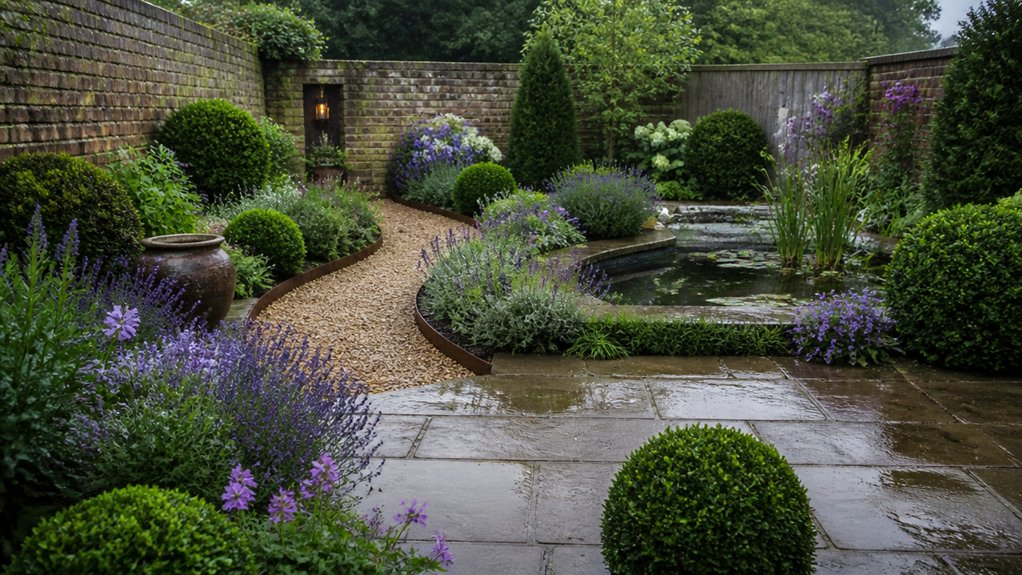
You can’t control British weather, but you can design planting schemes that keep working through heat, rain, and sudden cold snaps. Start by checking sun, soil, and drainage, then group plants by moisture needs so they hold their shape without constant fuss. Use mulches, groundcover, and repeat planting blocks to suppress weeds and simplify care. The key is choosing the right performers for each problem spot—and that’s where it gets interesting…
Key Takeaways
- Map sun, shade, wind, and post‑rain water flow to zone the garden and match plants to conditions for low maintenance.
- Test soil texture and pH; choose plants that suit drainage and acidity (e.g., heathers for acid, lavender for alkaline).
- Suppress weeds by mass planting for canopy closure, underplanting evergreen groundcovers, and mulching 5–7cm composted bark annually.
- Use condition-specific schemes: dry shade (Epimedium, hellebores, ferns), wet soil (iris, ligularia), full sun (lavender, nepeta, salvia).
- Reduce upkeep with hard-edged paths, defined borders, and resilient, wildlife-friendly perennials needing only annual cutback and light deadheading.
Low‑Maintenance UK Gardens: Check Sun, Soil and Drainage
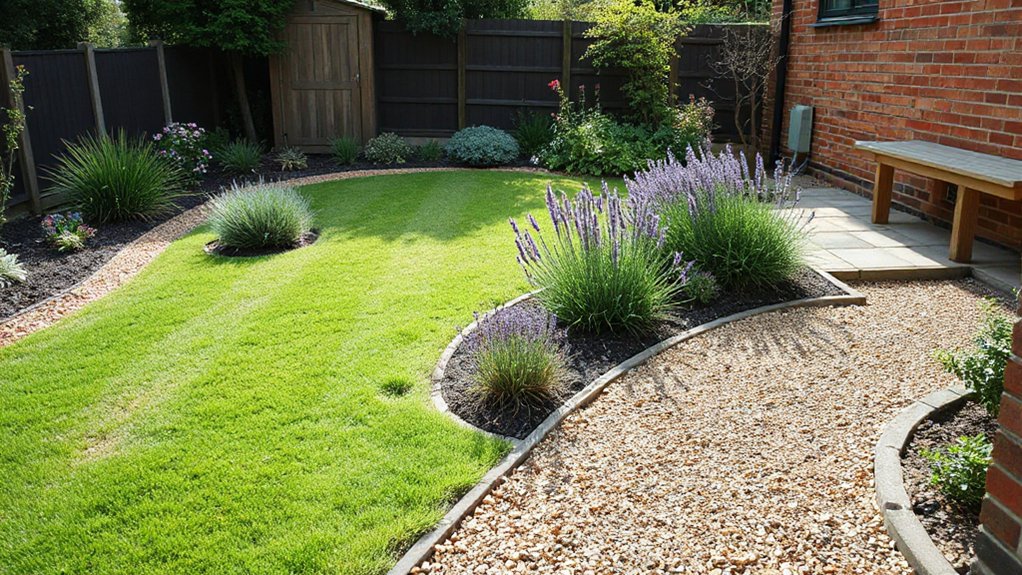
Before you choose a single plant, ask where your garden gets sun, where it stays shaded, and how water actually moves across the site. Map light in morning and late afternoon; British skies shift, so note wind exposure too.
Test soil texture by rubbing it damp: gritty drains fast, silky holds water, sticky compacts. Check pH with a kit, then match plants: heathers and blueberries like acid, lavender prefers alkaline.
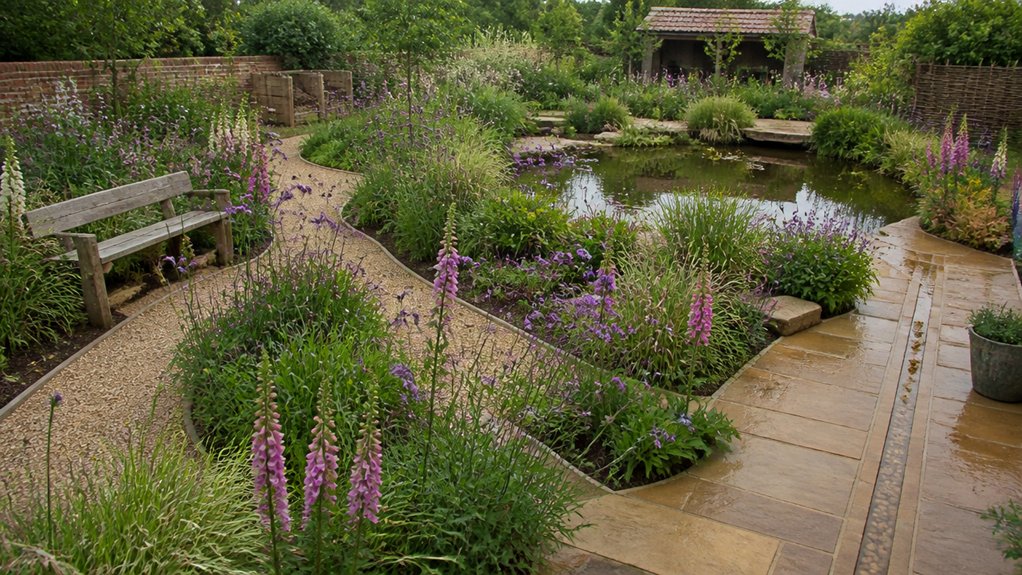
Watch after rain; puddles mark clay pans, while dry bands show runoff. Position garden furniture on the driest, most stable ground, and keep paths out of boggy channels.
Turn damp corners into wildlife habitats with iris, sedges, and log piles, and reserve free‑draining spots for thyme and rosemary.
Low‑Maintenance UK Garden Design That Stops Weeds
Although you’ll never eliminate weeding entirely, smart UK garden design can cut it to minutes a month by removing the conditions weeds love: bare, sunlit soil and disturbed edges.
Start by closing the canopy: mass perennials and shrubs so foliage meets by midsummer, then underplant with robust groundcover to block light.
Define crisp boundaries with steel edging or setts so lawn and borders don’t creep; keep paths hard‑edged and fully paved or tightly gravelled over a membrane.
Mulch once a year with 5–7cm composted bark or green waste to smother seedlings and stabilise moisture.
Group plants by vigour so you don’t over‑disturb soil during plant maintenance.
You’ll improve garden aesthetics while starving weeds of gaps.
Shade Planting Schemes: Tough Plants for Dry Shade
Start by reading your dry shade: check how much light filters in, how deep the soil is, and whether tree roots and rain shadow keep it starved of moisture.
Then you’ll choose drought‑tough shade perennials that hold form and flower without fuss—think Epimedium, Geranium macrorrhizum, Helleborus, and hardy ferns.
To lock in a low‑maintenance look, you can knit them together with evergreen groundcovers like Liriope, Pachysandra, or Vinca for a weed‑resistant, year‑round carpet.
Assessing Dry Shade Sites
When you’re planning for dry shade, you’ll get better results by reading the site like a plant would: light levels through the day, rainfall interception from trees or buildings, and the root competition that strips moisture from the topsoil.
Note whether shade is dense all day or dappled and shifting; that affects shade tolerance and how layered your planting can be.
Test soil with a trowel: if it’s dusty, shallow, or packed, you’ll need to open it up before establishing dry shade plants.
Check for hydrophobic leaf litter under conifers and a rain shadow by walls and fences.
Map the “dripline desert” under mature trees, then plan paths and focal points to avoid constant stress zones.
Drought-Tough Shade Perennials
Because dry shade combines low light with fierce root competition, you’ll get the most reliable planting by choosing perennials that hold firm foliage, run on modest moisture, and knit into a weed‑resistant ground layer.
Aim for tough clumps: Epimedium for spring flowers and leathery leaves; Geranium macrorrhizum for scented foliage; Helleborus for winter colour; and Pulmonaria for early nectar.
Thread in ferns like Dryopteris filix‑mas where soil stays cooler, and use Bergenia as a bold edging note.
Plant in repeating drifts to read as a scheme, not a collection, then mulch with leafmould to buffer drought.
Under drought resistant trees, avoid Wildflower mixes; instead, concentrate on shade-tolerant species and stagger bloom times through the year.
Evergreen Groundcover Combinations
Although dry shade can strip out all but the hardiest planting, you can keep the soil covered year‑round by pairing evergreen groundcovers that share a tolerance for low light, lean moisture, and root competition.
Start with Epimedium x perralchicum for wiry, weed‑excluding mats and spring flowers, then stitch in Geranium macrorrhizum to knit gaps and scent the edges when brushed.
For finer texture, add Asarum europaeum under shrubs, or use Vinca minor where you need fast coverage and blue bloom.
Your Groundcover selection should balance pace: slow spreaders near paths, quicker runners under trees.
Keep Evergreen foliage clean by raking leaf litter in winter, and mulch with composted bark to buffer dryness.
Cut back tatty stems in late spring.
Wet‑Soil Schemes: Plants That Cope With Boggy Ground
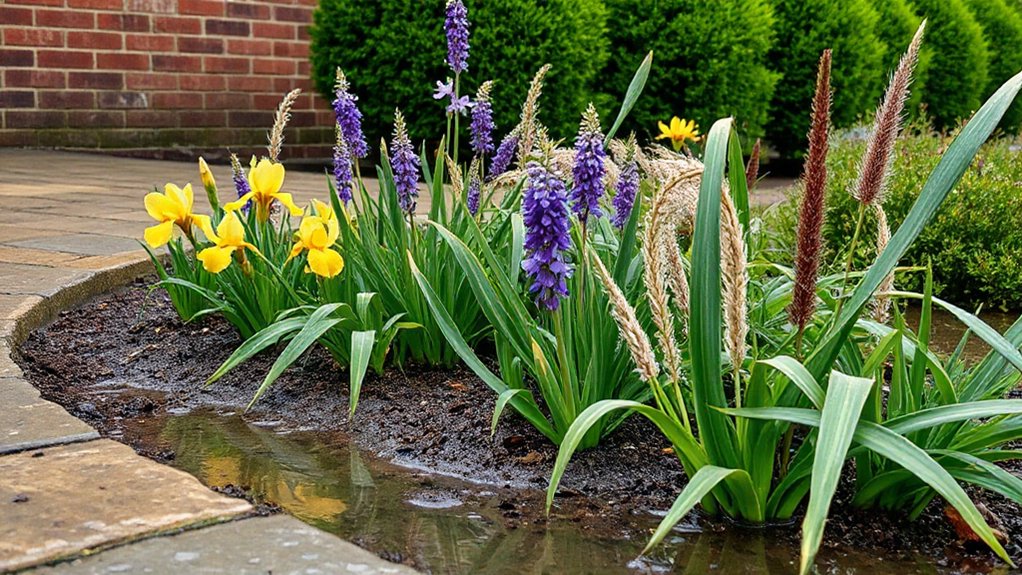
If your border stays saturated after rain, you can turn that boggy ground into a resilient planting scheme by choosing species that thrive with wet feet.
You’ll start with reliable perennials for constant moisture, then anchor the bed with shrubs that cope in waterlogged soil without sulking.
Finish the design with grasses and marginals to add vertical texture and a clean, naturalistic edge along the dampest zones.
Reliable Perennials For Wetness
When your borders stay waterlogged after rain, you don’t need to fight the conditions—you need perennials that root happily in wet, oxygen-poor soil and still deliver structure and colour. Build Perennial resilience by choosing plants with proven Wetness tolerance and strong basal growth that won’t rot at the crown.
For height, plant Iris pseudacorus or Filipendula ulmaria at the back; they anchor a scheme with bold leaves and summer plumes.
In the mid-layer, use Ligularia dentata for dark foliage and daisies, plus Persicaria bistorta for tidy, vertical spikes.
At the front edge, thread in Caltha palustris and Primula japonica for spring-to-early-summer colour, then add Carex elata ‘Aurea’ to keep light in the planting all year.
Shrubs For Boggy Borders
Because boggy ground starves roots of oxygen and encourages crown rot, you’ll get a cleaner, lower‑maintenance result by choosing shrubs that naturally tolerate saturated soils and then using them to build the permanent framework of the border.
Start with native species where you can: Salix cinerea or Salix purpurea handle winter flooding, knit soil, and supply early catkins for pollinators. Add Cornus sanguinea for tough, twiggy structure and winter stem colour, or Viburnum opulus for spring lacecaps and autumn berries.
If you want evergreen mass, place Ilex aquifolium on the slightly higher shoulder of the bed. Plant in broad drifts, leave access gaps for mulching, and let shrubs interlock to shade soil, suppress weeds, and build wildlife habitats year‑round.
Grasses And Marginals
Although shrubs give a boggy border its backbone, grasses and marginal plants supply the movement, seasonal lift, and edge-definition that make wet ground look intentional rather than simply soggy.
Use moisture-loving grasses like Deschampsia cespitosa and Molinia caerulea to knit gaps, then thread in Iris pseudacorus, Caltha palustris, and Carex elata for bold blades and clean margins.
Plant in drifts and repeat two or three species to keep the scheme calm. Set taller clumps at the back, and run low Carex or Acorus at the path edge to stop soil slumping.
You’ll get Wildlife attracting flowers, seedheads, and shelter, plus clear Seasonal variations: spring primrose-yellow, summer iris, autumn tawny panicles, and winter silhouettes.
Cut back in late winter only.
Full‑Sun Schemes: Drought‑Tolerant UK Performers
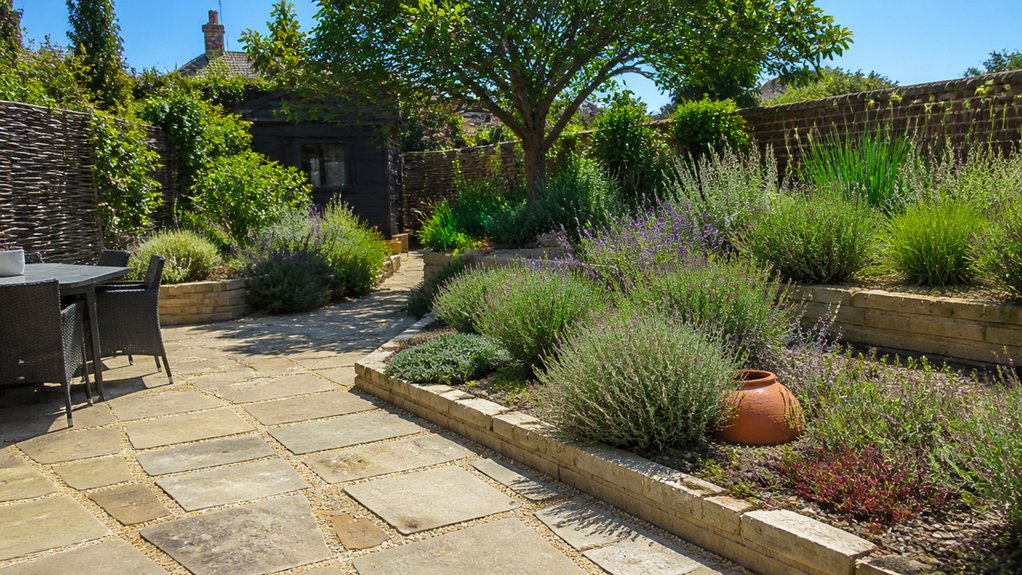
If your garden bakes in summer sun, you can still build a crisp, low‑maintenance scheme by leaning on drought‑tolerant UK performers that thrive on free‑draining soil and minimal fuss. Start with a gravel or grit mulch for Water conservation, then plant in drifts: lavender, nepeta, and salvia for long flower season and clean structure.
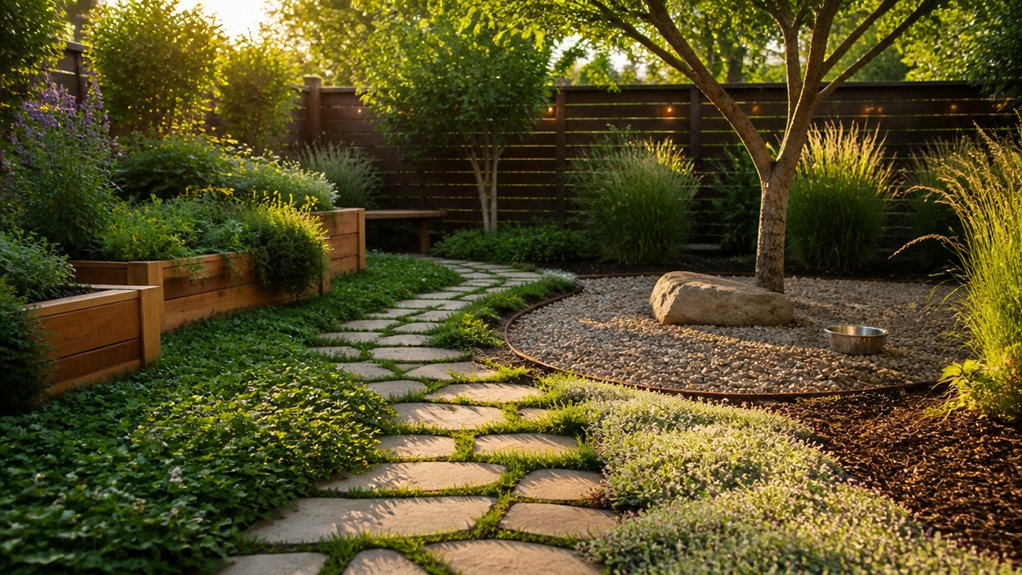
Thread in aromatic thyme and santolina at the front to knit edges and deter weeds. Add sculptural accents like euphorbia characias or stipa tenuissima for movement without thirsty borders.
For Wildlife friendly planting, mix in echinops, oregano, and sedum; their nectar keeps bees and hoverflies working through heatwaves. Water deeply to establish, then let roots chase moisture; deadhead lightly and cut back once yearly.
Windy‑Spot Schemes: Shelterproof Planting Combinations
Where wind scours borders and dries soil faster than sun, you can still keep a low‑maintenance scheme by planting in tight, interlocking layers that flex rather than snap.
Start with windbreak planting: stagger evergreen structure such as Griselinia littoralis, Elaeagnus × ebbingei, or a clipped yew screen to slow gusts without dead eddies.
In front, use shelter planting with tough, pliant shrubs—Escallonia, Rosa rugosa, and Hebe—then knit gaps with grasses like Calamagrostis ‘Karl Foerster’ and Festuca glauca.
Finish with ground‑hugging binders: Geranium macrorrhizum, thyme, and sedum to seal soil and reduce desiccation.
Mulch deeply, water in once, and let roots anchor the whole composition through winter storms.
Low‑Maintenance Pots: Reliable Mixes for Year‑Round Colour
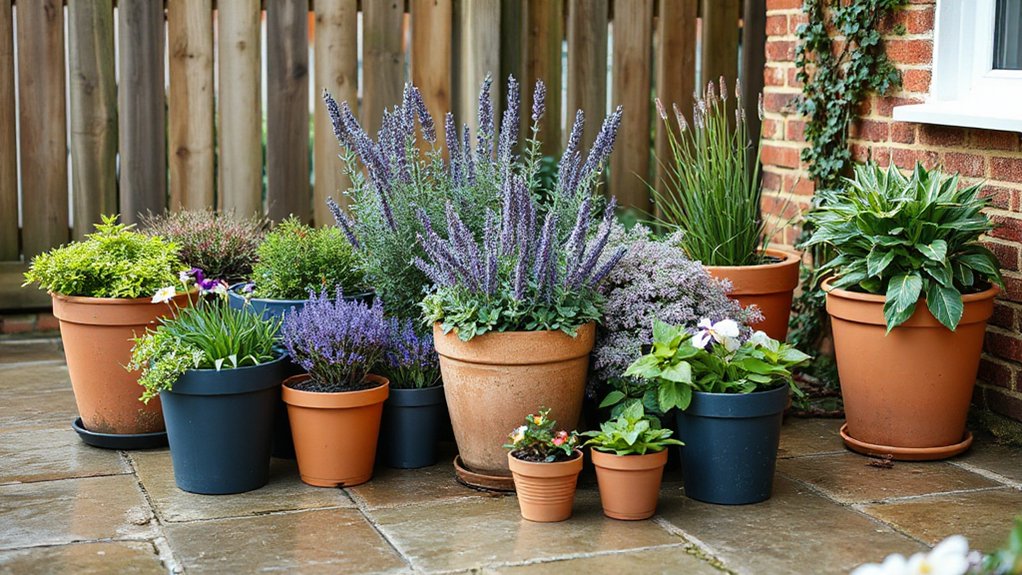
Because pots expose roots to faster drying and colder snaps than borders, you’ll get year‑round colour with less effort by building each container like a mini planting scheme: one evergreen “backbone”, one long‑flowering or colour‑shift plant, and one trailing or ground‑covering spiller to knit the rim.
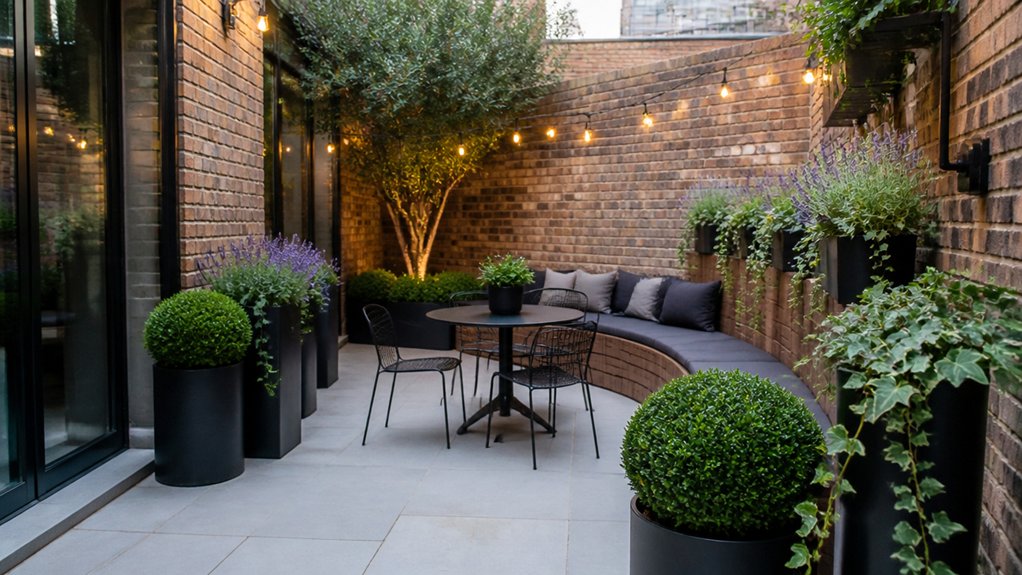
Choose container combinations that share moisture needs and tolerate rain. For a cool, reliable mix, pair heuchera for foliage shifts, cyclamen for winter flowers, and ivy to drape.
For sunny patios, combine lavender, calibrachoa, and creeping thyme for scent and continuous bloom.
Use seasonal color coordination by repeating one hue across pots, then swapping only the flowering plant in spring or late summer.
Plant into peat‑free compost with grit, top‑dress with gravel, and water deeply, less often.
Year‑Round Structure: Evergreen Shrubs, Grasses and Bulbs
Although flowers come and go, you can keep a UK garden looking composed in every month by building a simple framework of evergreen shrubs for weight, grasses for movement, and bulbs to punctuate the gaps with timed colour.
Start with Evergreen plants such as Ilex crenata, Pittosporum tenuifolium, or Sarcococca for dense form and winter scent; repeat them in threes to anchor views.
Thread in grasses—Calamagrostis ‘Karl Foerster’, Deschampsia, or Carex—so wind animates the planting even in rain.
For Bulb planting, tuck narcissus, crocus, and alliums between shrubs and under grasses, planting in drifts and at varied depths for a natural rhythm.
Leave seedheads standing, cut back in late winter, and you’ll reset the display with minimal work.
Frequently Asked Questions
How Often Should I Water a Low‑Maintenance Garden During UK Summer Heatwaves?
During UK summer heatwaves, you’ll water deeply 1–2 times weekly, at dawn, adjusting your watering schedule to soil and wind. Group drought resistant plants, mulch 5–7cm, and target roots to reduce stress and evaporation.
What’s the Best Way to Improve Clay Soil Without Constant Digging?
You’ll improve clay soil best by top‑dressing, not turning it: use compost application in autumn and spring, add organic amendments like leaf mould, and mulch deeply. You’ll boost structure, drainage, and planting design over time.
Which Plants Are Safe for Pets and Wildlife in Low‑Effort Planting Schemes?
Choose Pet friendly plants like catmint, calendula, and snapdragons, and build Wildlife friendly planting with lavender, marigold, and sunflowers. You’ll layer herbs, flowers, and grasses for structure, nectar, and safe browsing.
How Can I Prevent Slugs and Snails Without Using Chemical Pellets?
Stop slugs and snails by inviting Natural predators with ponds, log piles, and bird habitat, then add barrier methods: copper tape, grit rings, and wool pellets. You’ll water mornings, lift pots, and hand‑pick.
What’s the Cheapest Way to Create a Low‑Maintenance Garden From Scratch?
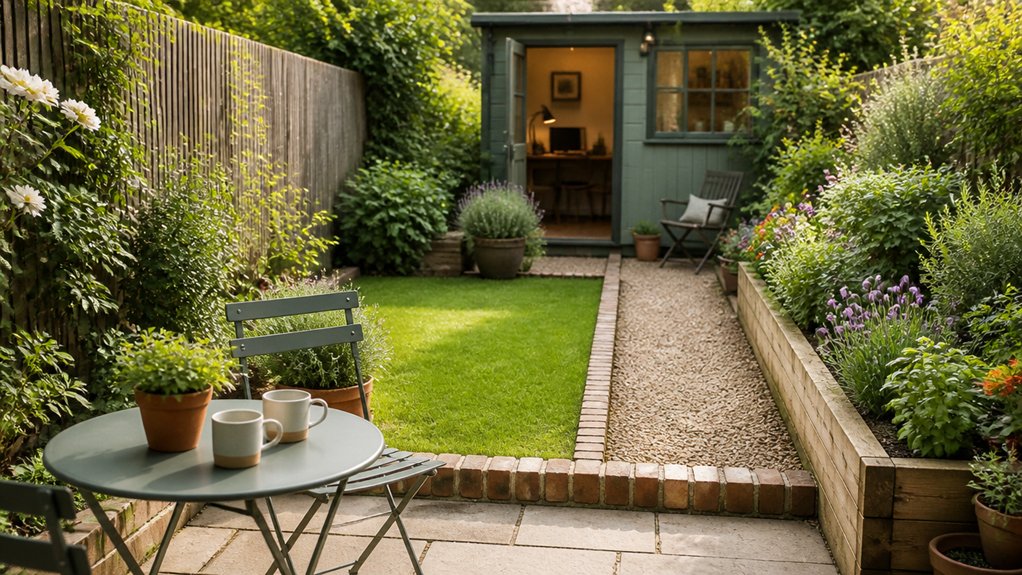
On a shoestring, you’ll start by simplifying your Garden layout: keep beds compact, reuse edging, and mulch deeply with free compost or chips. Focus Plant selection on tough perennials and groundcovers, then add rainwater harvesting.





Leave a Reply