

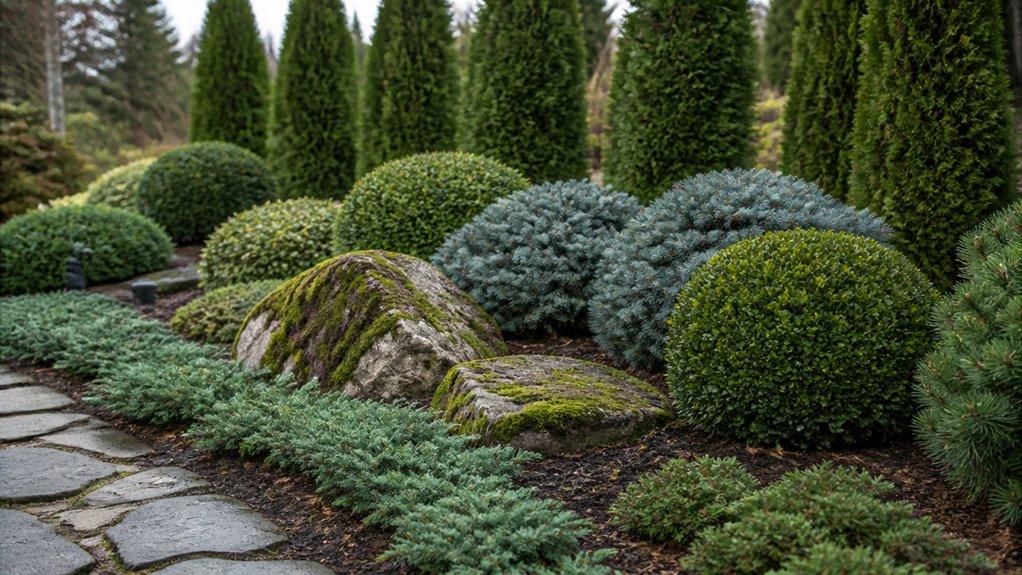
You probably don’t know that most “evergreen failures” come from site mismatch, not plant choice—winter sun, wind exposure, and soil drainage drive dieback more than cold. You’ll get stronger year‑round structure when you map light and moisture first, then layer tall, mid, and low evergreens to control sightlines and scale. Use narrow verticals, dense mid-mass, and edge-softening ground covers, but don’t let them fuse into a flat green wall—your spacing plan is where it gets interesting…
Key Takeaways
- Assess sun, wind, drainage, and mature clearances first, then prep soil and irrigation zones for reliable evergreen establishment.
- Build layered structure: tall narrow conifers, mid mounded shrubs, and low groundcovers to fill gaps and hide mulch.
- Use screening evergreens to frame views and create thresholds; taper heights and maintain sightlines at drives, paths, and entrances.
- Mix foliage colors and textures—blue, gold, and variegated forms—for contrast, winter brightness, and stress-tolerant plant choices.
- Create rhythm with staggered spacing, alternating masses and voids, and anchor focal points like columnar conifers or clipped spheres.
Start With a Site Check and Evergreen Plan
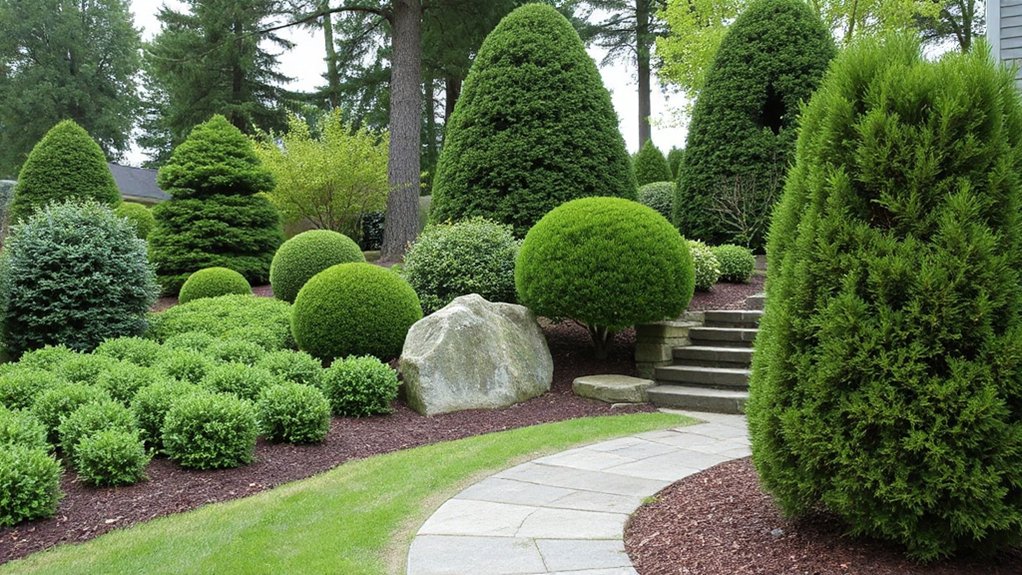
Before you buy a single evergreen, map your site’s constraints and opportunities so your planting plan performs year‑round. You’ll flag sun angles, winter shade, prevailing winds, and reflected heat from paving, then match species to microclimates. Test drainage by timing percolation after irrigation; note frost pockets and salt-splash zones near walks and roads.
Next, lock in functions: screening, framing views, or anchoring entries, and set mature size clearances from eaves, utilities, and sightlines.
Prioritize Soil preparation by correcting compaction, adjusting pH to target ranges, and amending only as your soil texture warrants. Plan irrigation zones for establishment and drought cycles.
For Wildlife attraction, specify berrying or cone‑bearing evergreens and protect them from browse with spacing and barriers.
Build Layers With Tall, Mid, and Low Evergreens
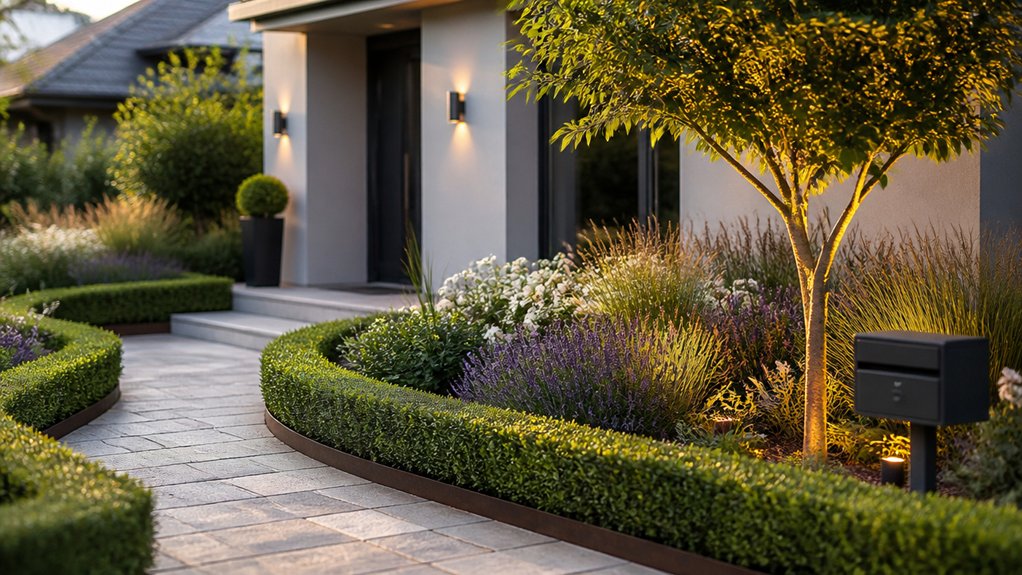
Although a single evergreen can anchor a bed, layered structure is what makes a planting read as intentional in every season. Start by setting a tall tier where soil volume and wind exposure can support it: narrow conifers, columnar hollies, or upright junipers give vertical mass without overcasting. Keep the canopy line clean and repeat forms to unify the composition.
Next, build a mid layer that controls bulk and shadow: mounded yews, boxwood, or broadleaf evergreens like inkberry knit the bed together and reduce visual gaps.
Finish with a low tier that hides mulch and edges: creeping juniper, wintercreeper, or dwarf spruce. Use Layering techniques that step down from back to front, matching mature width to spacing. Mix Evergreen varieties for texture, not height alone.
Use Screening Evergreens to Frame Views and Paths
Once you’ve built a layered planting, use screening evergreens to control sightlines and give paths and views a clear start and stop. Place taller screens perpendicular to circulation to create “thresholds,” then taper height to pull the eye forward.
Align hedges with property lines, wall planes, and the path centerline so enclosure feels intentional, not accidental.
Choose evergreen varieties by mature width and density, not just height; tight-branching forms read as walls, while looser forms filter views. Set plants far enough off paths for snow load and maintenance access, and keep sight triangles open at junctions.
Use seasonal pruning to maintain a crisp face and consistent top line, especially at turns where geometry telegraphs direction. Let openings frame focal objects, not clutter.
Add Year-Round Color and Texture (Blue, Gold, Variegated)
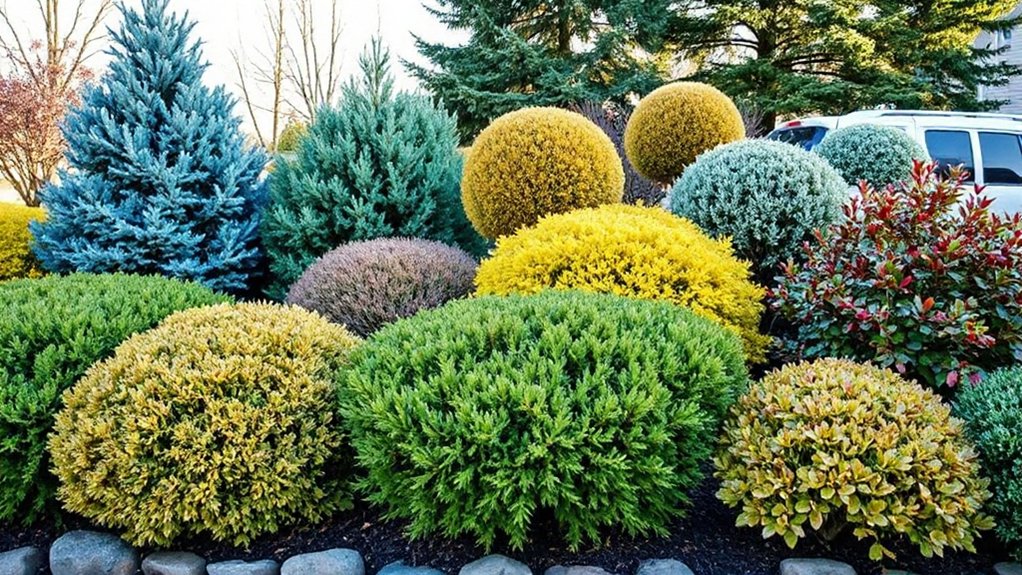
When your backbone evergreens lock in structure, you can add year‑round color and texture by inserting blue, gold, and variegated forms as deliberate wayfinding and contrast tools. Use blue needles to cool hot exposures and visually push boundaries back; place gold foliage where low winter light needs lift.
Variegation reads best at midrange viewing distances, so specify it near entries, turns, and terrace edges for legibility.
Match color to site stress: choose glaucous conifers and silver‑leaf broadleaf evergreens as drought tolerant varieties for reflective heat and lean soils.
Balance persistent foliage with seasonal bloomers nearby, so spring and summer flowers ride atop stable color blocks without relying on bare stems.
Keep textures intentional—fine needles against bold leaves—to sharpen shadows and maintain depth through winter.
Avoid the “Green Wall”: Spacing, Rhythm, and Focal Points
Blue, gold, and variegation sharpen contrast, but tight, uniform spacing can still read as a flat “green wall” from the street or terrace. Break that plane by sizing intervals to mature spread, not pot width, and by alternating masses with voids that reveal hardscape.
Step heights in a repeatable sequence—low mound, mid screen, tall accent—so you create rhythm and seasonal contrast without visual noise. Offset plant centers in a staggered grid to soften alignment and improve air flow.
Then anchor the composition with focal points: a single columnar conifer at an entry, a clipped sphere at a turn, or a specimen with a distinct winter silhouette. Use foliage diversity to separate layers and keep depth legible year-round.
Frequently Asked Questions
What Evergreens Are Safest for Homes With Dogs and Cats?
Choose pet-safe evergreens like rosemary, thyme, and camellia; avoid yew, oleander, and sago palm. You’ll balance lush massing with low-risk chemistry—Pet safe foliage, Non toxic plants—while specifying clean edges, defined layers, controlled growth.
How Often Should I Water New Evergreens During Their First Year?
Water new evergreens weekly their first year, twice weekly in heat, delivering 1–2 inches. You’ll stabilize root zones through Soil preparation and mulch; follow Pruning techniques sparingly to reduce stress and transpiration.
When Is the Best Time to Prune Different Evergreen Species?
You’ll prune most evergreens in late winter/early spring before new growth; lightly trim in midsummer to refine lines. Seasonal timing varies: pines candle-prune in spring, spruces/cedars shear early summer. Use precise pruning techniques.
Which Evergreens Perform Best in Containers Through Winter?
You’ll get winter-proof container performance from dwarf conifers (mugo pine, spruce), boxwood, and hardy hollies—an absolute fortress. For Container design, match root-hardiness to pot size; for Seasonal color, pair with variegated euonymus, red-stem dogwood.
How Can I Protect Evergreens From Deer and Rabbit Damage?
You’ll protect evergreens by installing 7–8′ fencing, adding trunk guards, and rotating repellents. Use Deer deterrent methods like scent sprays and motion lights. Specify Rabbit proof plants, plus hardware-cloth collars at grade.

Leave a Reply