

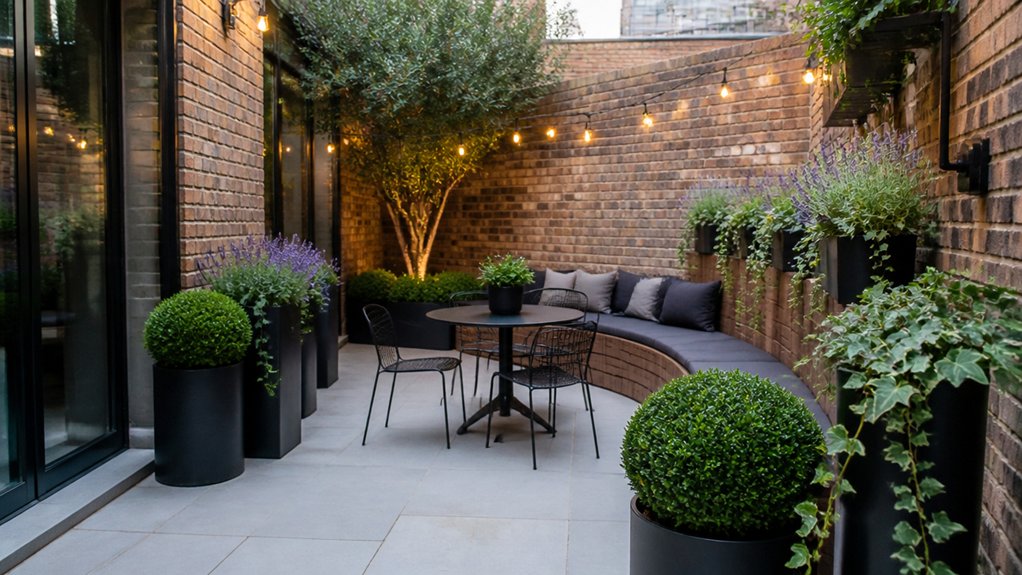
You can make a tight British courtyard feel modern and calm if you plan the layout first, then layer plants up the walls and along the edges. Use large-format paving to stretch the sightlines, add slim screens for privacy, and tuck climbers into narrow beds or vertical planters. Choose shade-tolerant, seasonal performers with fragrance, then fit a compact bench and low-glare lighting. Next, you’ll need to decide what takes priority…
Key Takeaways
- Plan from hard edges, map sun and sightlines, and zone space into dining, green buffer, and a focal point with tight circulation.
- Use vertical structure—pleached trees, espalier, slim screens, and wall climbers—to add height and privacy without losing floor area.
- Choose a calm modern palette with repeated evergreen shapes, glossy foliage, and shade-tolerant perennials for year-round interest.
- Make paving feel bigger using large slabs, diagonal laying, light materials, and small planting joints with thyme or chamomile.
- Layer warm, low-glare lighting—ankle lights, uplights, and hidden LED strips—with dimmers to extend use and create evening atmosphere.
Plan a Modern British Courtyard Garden Layout
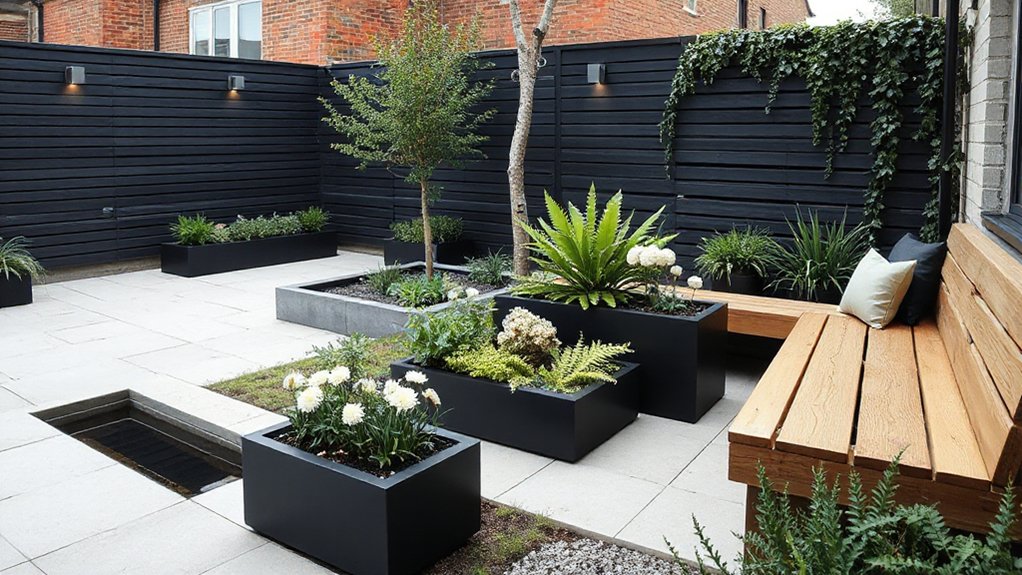
If you start with the hard edges, the plants fall into place faster. Mark sun, shade, and sightlines from doors and windows, then zone the courtyard into a dining perch, a green buffer, and a focal corner. Keep circulation tight and straight so every bed earns space.
Anchor the layout with one vertical layer: pleached hornbeam, espaliered apple, or slim bamboo screens for privacy. Mass plants in repeats—box balls, hebe, pittosporum, and ferns in shade—to read modern and calm. Tuck herbs and grasses along edges for scent and movement.
Place garden furniture where it won’t block growth, and soften it with pots of sarcococca. Add water features as a small rill or wall spout to mask traffic noise.
Make a Small Courtyard Feel Bigger With Paving
Choose large-format slabs to cut down grout lines so your planting beds, pots, and climbers read as the main texture.
Lay pavers diagonally to pull the eye across the courtyard and make narrow runs feel wider beside your greenery.
If you can, extend the same paving indoors at the threshold to blur the boundary and stretch the garden’s footprint.
Use Large-Format Slabs
Although planting usually steals the spotlight, paving sets the scale in a tight courtyard, and large-format slabs can make the whole space read as calmer and bigger.
Choose Large format slabs with minimal joints so your eye skips over interruptions and reads one continuous plane. Keep grout lines tight and consistent, and pick a pale limestone, buff porcelain, or mid-grey sandstone to bounce light back onto your borders.
Run slabs to the longest dimension to emphasise length without extra tricks. Use simple paving patterns—straight stack or subtle stretcher bond—so clipped box, ferns, and shade grasses feel intentional, not busy.
Set a slim channel drain and leave a 10–15mm planting gap for thyme, mind-your-own-business, or creeping chamomile to soften edges without shrinking space.
Lay Pavers Diagonally
When you rotate your paving pattern 45 degrees, the eye tracks longer sightlines across the courtyard, so the footprint reads wider and less boxed-in. Set Diagonal pavers from your main threshold to the brightest corner to pull attention outward, not back to the walls.
Keep joint lines crisp and consistent; a tight, weed-resistant pointing makes the geometry read as intentional, not fussy. Use pattern contrast to steer movement: pair a calm mid-grey field with a slim charcoal soldier course, or switch the paver orientation in a small seating bay to “zone” it without adding bulk.
Let planting soften edges—thread thyme between steps, tuck ferns into shaded corners, and keep containers aligned to the diagonal for a clean finish.
Extend Paving Indoors
If you run the same pavers from your kitchen or hallway straight out into the courtyard, you erase the “threshold break” and the space reads as one longer room. Keep joints aligned to door frames, and choose a slim, flush threshold channel so the line doesn’t stutter.
Use light, matte stone or porcelain to bounce daylight back onto interior walls and planting.
Treat the courtyard as an indoor patio: place tall, narrow planters tight to boundaries, then let paving dominate the centre for clear sightlines. Continue the bond pattern as a deliberate floor extension, but switch to a slightly rougher finish outdoors for grip.
Tuck irrigation lines under edge restraints, and lift pots on feet so water drains cleanly.
Add Courtyard Garden Privacy With Screens and Planting
Because tight courtyards sit so close to neighbours, you’ll get the biggest comfort boost by layering privacy with slimline screens and purposeful planting. Fix privacy screens to posts or fences to block direct sightlines while keeping light and airflow. Choose dark, matt finishes so greenery pops and the boundary recedes.
Then plant in narrow troughs and tall pots to soften edges without stealing floor space. Use upright evergreens like clumping bamboo, yew columns, or Portuguese laurel standards for year-round cover. Thread in lighter textures—hakonechloa, ferns, and heuchera—at the base for depth.
Add scent near seating with jasmine-like sarcococca or lavender. For vertical planting, hang pocket planters on the screen and tuck in trailing ivy-leaf geraniums.
Use Courtyard Walls for Climbers and Vertical Planters
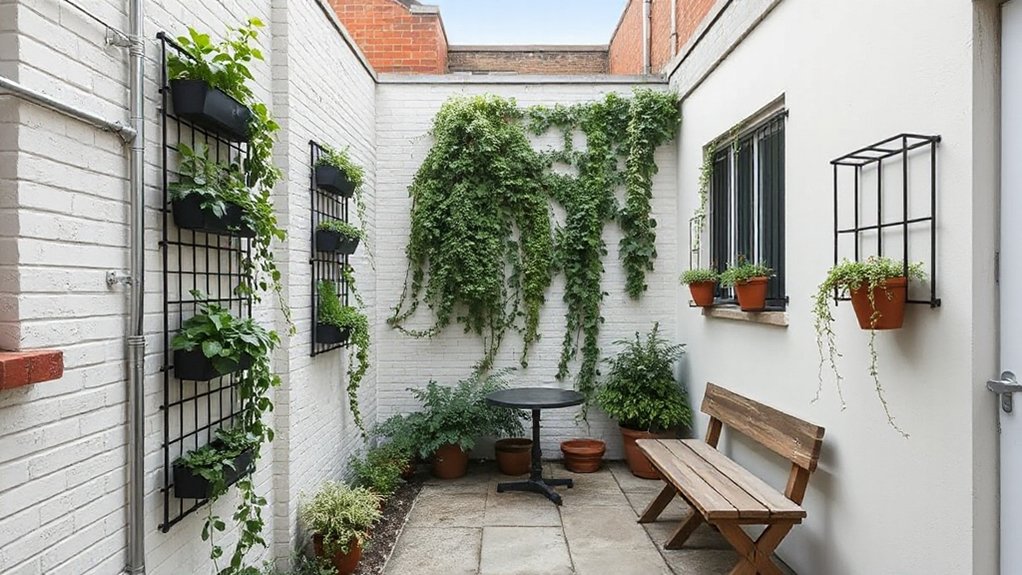
Use your courtyard walls as planting space by training climbers on slim trellises or tension wires, keeping stems tight to the brickwork.
Add vertical wall planters for herbs, ferns, or compact perennials, and group them where you can water and deadhead quickly.
Choose space-saving species—evergreen jasmine, star clematis, or dwarf ivy—that stay narrow, flower well, and cope with shade or reflected heat.
Train Climbers On Trellises
While floor space disappears fast in a British courtyard, your walls can still carry serious planting weight when you train climbers on slim trellises and vertical planters. Fix garden trellises 5–10cm off the wall so stems dry quickly and mortar can breathe.
Choose climbing plants to match light: star jasmine or climbing hydrangea for shade; clematis, honeysuckle, or roses for sun.
Set wires or a fan trellis to spread growth, then tie in new shoots weekly with soft twine, keeping one strong leader vertical and laterals angled for more flowers.
Prune after flowering to stop bulk, and feed with a slow-release rose or clematis fertiliser.
Add drip irrigation at the base in summer.
Install Vertical Wall Planters
Even if your courtyard barely fits a bistro set, you can stack planting up the wall with vertical planters that turn blank brick into a living screen. Fix wall-mounted planters to sturdy masonry with appropriate anchors, then group pockets in columns to keep watering simple and drips contained.
For vertical gardening, mix container depths: shallow troughs for compact root zones, deeper modules for fuller growth. Add a slim drip line or a watering tube behind panels so you don’t soak paving.
Line each pocket with coir or geotextile to hold moisture while letting air reach roots. Leave a hand’s width between planters and the wall to improve airflow and reduce damp.
Finish with a removable tray at the base to catch runoff.
Choose Space-Saving Species
Because every square metre counts in a British courtyard, choose plants that climb, trail, or stay compact so your walls and vertical planters do the heavy lifting. Train climbers like star jasmine, honeysuckle, or climbing hydrangea on wires; they green up brick fast without stealing floor space.
For edible height, use cordon apples or espalier pears against sunny walls, pruning twice yearly to stay flat.
Fill vertical pockets with trailing ivy-leaved toadflax, compact ferns, or alpine strawberries for quick coverage.
At ground level, anchor beds with Compact evergreens such as dwarf box alternatives, hebe, or small yew domes for year-round structure.
Tuck Native shrubs like dwarf hazel, guelder rose, or dogwood into narrow borders, keeping stems thinned so light still reaches lower planting.
Choose Courtyard Garden Plants for Shade and Seasons
When your courtyard sits in shade for much of the day, you can still build strong structure and year-round interest by pairing evergreen backbone plants with seasonal shade performers. Start with shade tolerant plants that hold shape: clipped box alternatives like Ilex crenata, Sarcococca for winter scent, and small-leaved ferns for texture.
Add glossy foliage from hellebores and Epimedium to knit gaps in borders and containers.
For seasonal flowering choices, layer bulbs and perennials for a rolling display: snowdrops and Cyclamen coum in late winter, then Aquilegia, foxgloves, and hardy geraniums in spring.
In summer, rely on Hydrangea serrata, Japanese anemones, and Astrantia for long bloom.
Finish with autumn colour from Heuchera and evergreen ivy groundcover.
Fit Space-Saving Seating in a Courtyard Garden
Although planting usually gets top billing, you’ll use a tight courtyard far more if you build in seating that doesn’t steal border space or light from your containers. Start with a slim wall bench: fix battens to masonry, leave a 10–15cm gap behind for climbers, and angle the seat slightly so rain runs off.
Choose compact furniture that folds flat or nests, and park it under an overhang so pots keep prime sun. Add multi functional seating: a storage bench for compost scoop, ties, and hand tools; or a planter-edge ledge that doubles as a perch while you deadhead.
Keep legs minimal to protect paving flow, and set seats beside scented plants—thyme, mint in pots, or jasmine—so you brush fragrance as you sit.
Light a Modern Courtyard Garden for Evenings
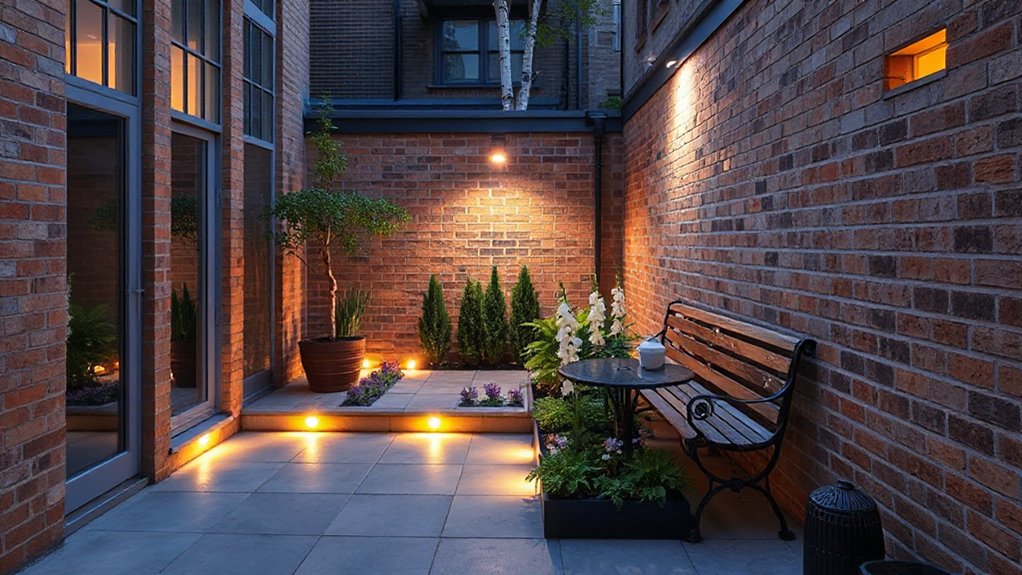
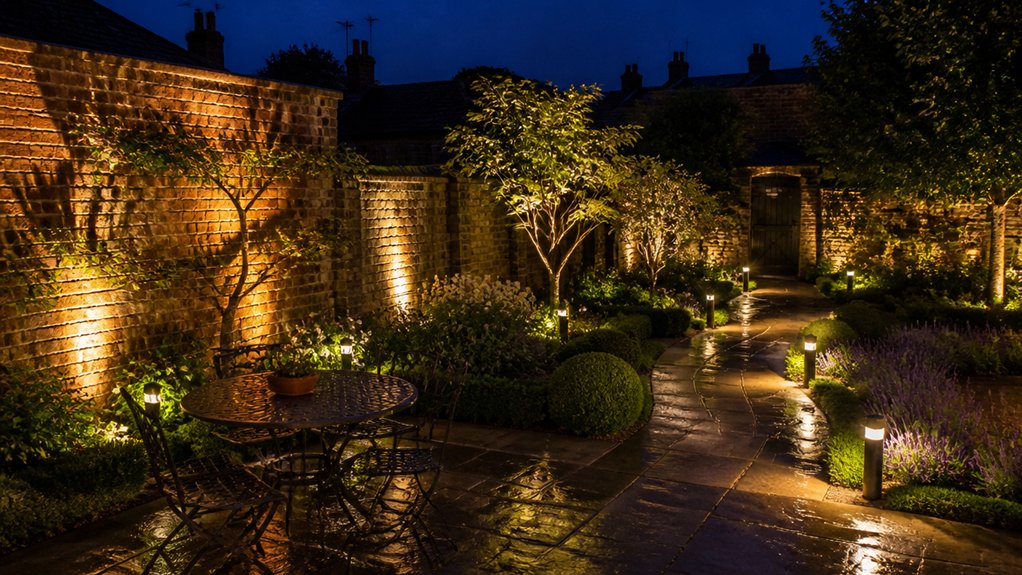
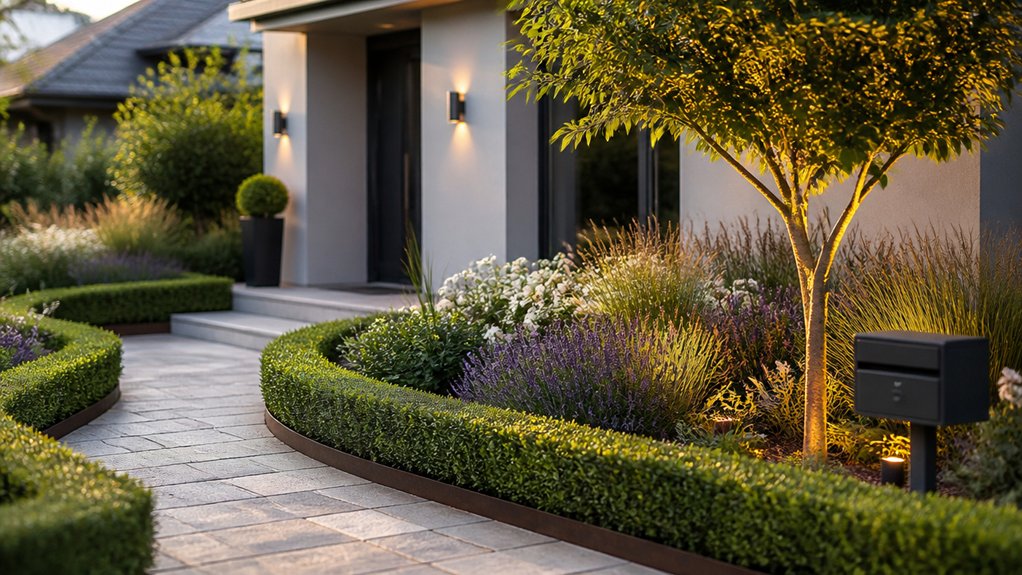
Even if your courtyard only stretches a few metres, layered lighting turns it into an evening garden and keeps plants looking crisp instead of flat. Start with warm Outdoor lighting at ankle height: recessed step lights or slim spike spots aimed across foliage, not into eyes.
Uplight a multi-stem acer or bay to show bark and canopy, then add a downlight from a wall bracket to mimic moonlight on ferns and hostas.
Use LED strip under benches and along raised planters to outline edges and prevent trips. Pick 2700–3000K bulbs for true greens, and shield fittings so leaves glow, not glare.
Put everything on a dimmer or smart timer, so you control evening ambiance from dinner to last drink outdoors.
Frequently Asked Questions
Do I Need Planning Permission for Courtyard Landscaping Changes in the UK?
You usually don’t need planning permission for courtyard landscaping in the UK, but you might if you alter levels, add tall Privacy screens, or wire Garden lighting. Check conservation areas, listed status, drainage, and neighbour impacts.
What’s the Best Way to Improve Drainage in a Small Paved Courtyard?
Like giving your courtyard a lifeline, you’ll improve drainage by regrading to a channel drain and soakaway, adding permeable paving options. Use Drainage solutions: gravel strips, raised planters, French drain; keep joints clear, water plants.
How Can I Reduce Wind Tunnelling in a Narrow Courtyard Garden?
You can reduce wind tunnelling by breaking airflow with Windbreak solutions: install slatted screens or trellis. Add Shelter planting—clump-form grasses, bay, pleached hornbeam, and climbers—layered at varied heights for calmer microclimates.
Which Materials Are Safest for Non-Slip Courtyard Surfaces in Wet Weather?
Choose textured porcelain pavers, flame-finished granite, or broom-finished concrete; they’re weather resistant materials. You’ll boost grip with non slip coatings or resin-bound gravel. Keep joints moss-free, add drainage channels, and site pots away.
How Do I Keep Courtyard Plants Healthy if I’M Away Frequently?
You’ll keep courtyard plants healthy by installing drip irrigation on a timer, grouping pots by water need, using Indoor watering trays for emergencies, and scheduling weekly checks for yellowing. Boost Pest management with neem, sticky traps.


Leave a Reply