

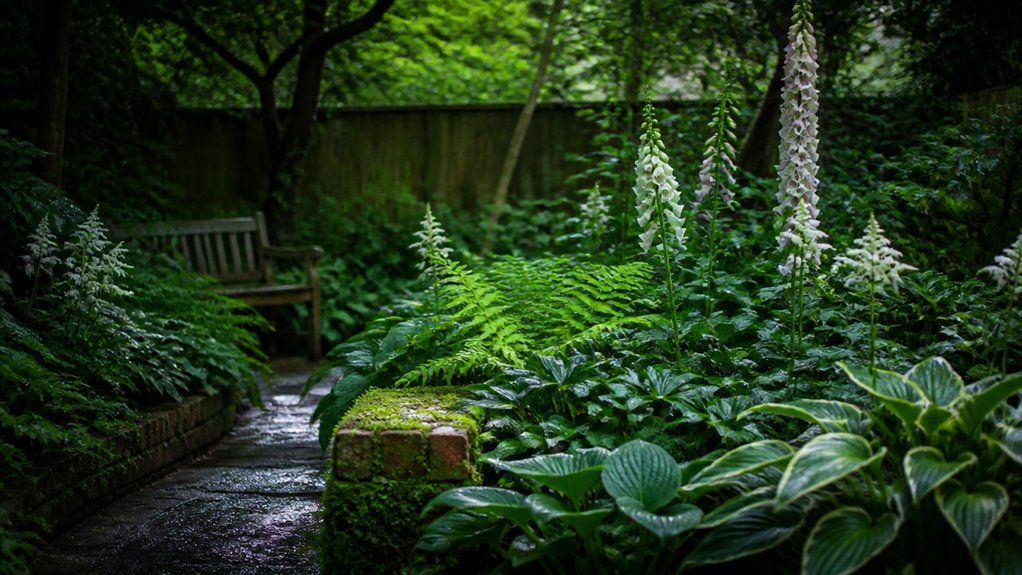
In one north-facing London courtyard I measured barely 1–2 hours of direct sun in June, and it behaved like a cool green room rather than a border. If you map your shade as dry under trees, damp by walls, or consistently north-facing, you can match plants precisely—think Hosta ‘Halcyon’, Dryopteris affinis, Epimedium ‘Frohnleiten’, and Sarcococca confusa. The difference comes down to soil moisture and spacing, and that’s where it gets interesting…
Key Takeaways
- Identify shade type—dry, damp, or north-facing—and match plants to that microclimate for better establishment and fewer failures.
- Improve soil for conditions: leafmould for dry shade, bark plus grit for damp shade, and keep crowns slightly raised to prevent rot.
- Use reliable shade foliage plants like epimedium, hosta ‘Halcyon’, heuchera ‘Obsidian’, and ferns for long-lasting colour and texture.
- Add year-round structure with evergreens such as sarcococca, aucuba, skimmia, vinca, and pachysandra to brighten low-light borders.
- Manage moisture and airflow: deep-soak dry shade weekly in drought, enhance drainage in damp shade, and space plants well to reduce mildew.
UK Shade Types: Dry, Damp, and North-Facing
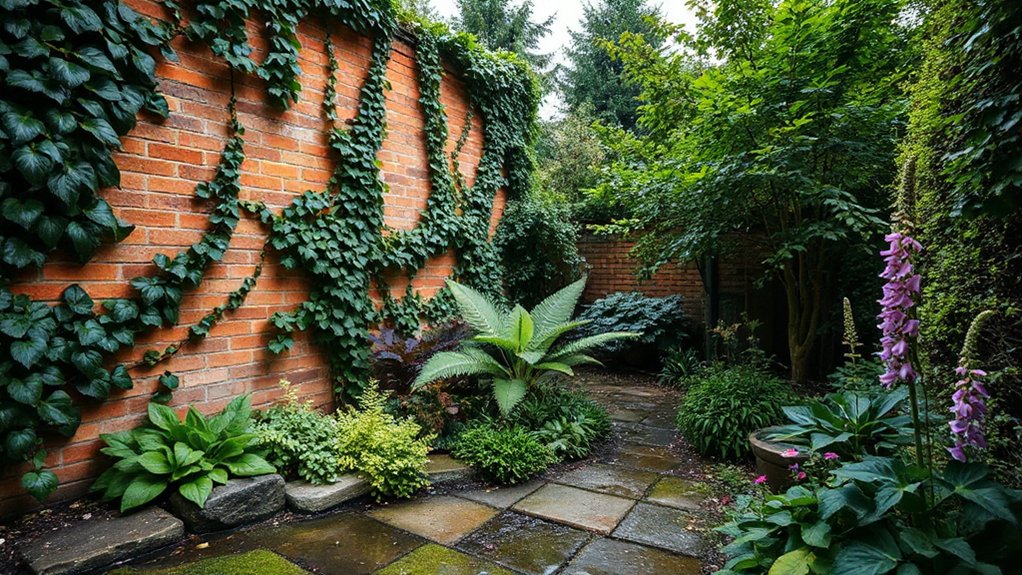
Although “shade” often gets treated as a single condition, UK gardens usually fall into distinct shade types—dry shade under trees or overhangs, damp shade in low-lying or poorly drained pockets, and north-facing shade with cooler, slower-to-warm walls and fences—and you’ll get far better results if you match cultivars to the microclimate rather than relying on generic “shade-loving” labels.
In dry shade, measure rain shadow and root competition; choose drought-tolerant shade adaptation and mulch to stabilise moisture.
In damp shade, check winter waterlogging and summer humidity; prioritise cultivars proven in heavy soils, and improve structure with leafmould rather than grit alone.
On north-facing aspects, track light windows and reflected brightness; you’ll need plants that tolerate cooler soils and delayed spring warmth.
Think of plant moonlighting: one cultivar excels in shade yet also handles brief sun if sheltered.
Top Shade-Loving Plants (UK) for Foliage
When you garden for shade in the UK, foliage plants usually give you the most reliable “wow” because they don’t depend on high light levels to flower well. The best picks vary sharply with dry root-competitive shade, damp heavy shade, or cooler north-facing pockets.
For dry shade under trees, choose Epimedium x perralchicum ‘Frohnleiten’ and Geranium macrorrhizum ‘Spessart’ for tough, scented leaves. Do light shade plant pruning after growth to refresh.
In damp shade, go for Dryopteris wallichiana and Hostas like ‘Halcyon’, but keep slug pressure low.
In cool north-facing spots, Heuchera ‘Obsidian’ and Polystichum setiferum ‘Herrenhausen’ hold colour.
Check soil acidity preferences: Skimmia japonica ‘Rubella’ prefers acidic compost, while most ferns tolerate neutral, moist loam.
Best Flowering Shade Plants for UK Borders
Because most shade borders in the UK still get a few hours of bright, indirect light (or seasonal spring sun before trees leaf out), you can rely on a tight shortlist of proven flowering cultivars—so long as you match them to the microclimate.
In dry shade under trees, plant Geranium macrorrhizum ‘Bevan’s Variety’ for reliable pink and resilience.
In moist, humus-rich shade, choose Astilbe ‘Fanal’ or ‘Deutschland’ for summer plumes, and Helleborus x hybridus ‘Harvington’ strains for late-winter colour.
In cool, north-facing borders, Brunnera macrophylla ‘Jack Frost’ adds spring flowers without scorching.
Track seasonal shade plant changes: early light suits hellebores; summer gloom favours astilbes.
For Shade plant propagation, divide geraniums and brunneras in autumn, and lift-split astilbes in early spring.
Evergreen Shade Plants for Year-Round Shape
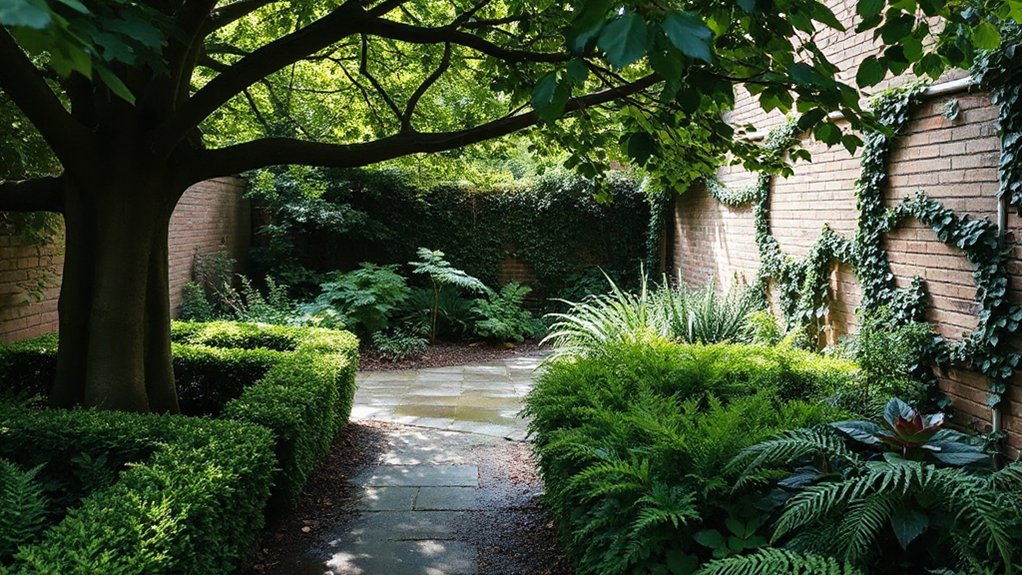
To keep shaded UK borders looking intentional through winter, you’ll rely on evergreen groundcovers like *Vinca minor* ‘Gertrude Jekyll’ or *Pachysandra terminalis* that hold cover in dry shade if you add leaf-mould and conserve moisture.
You can anchor the space with shade-tolerant structural shrubs—*Sarcococca confusa*, *Aucuba japonica* ‘Crotonifolia’, or *Skimmia japonica*—choosing cultivars to match your microclimate (wind exposure, frost pockets, and soil dryness under trees).
Then you’ll sharpen the composition with foliage texture and contrast by pairing bold leaves (e.g., *Fatsia japonica*) with finer evergreens such as *Polystichum* ferns.
Reliable Evergreen Groundcovers
Although deep shade can thin out many low growers, several evergreen groundcovers hold their form year-round in UK gardens if you match the cultivar to your microclimate (dry shade under trees, damp shade by walls, or wind-scoured coastal sites).
In dry shade, choose Epimedium x perralchicum ‘Frohnleiten’ for leathery leaves and steady spread, or Geranium macrorrhizum ‘Bevan’s Variety’ where roots compete.
For damp shade, Asarum europaeum keeps glossy, slug-resistant foliage, while Pachysandra terminalis ‘Green Sheen’ knits soil on heavier clay.
In mild coastal shade, Vinca minor ‘Bowles’s Variety’ resists wind and gives long flowering.
If you want shade-loving succulents, try hardy Sedum spurium ‘Dragon’s Blood’ in bright, dry shade.
These evergreen groundcover options reduce weeding and stabilise soil year-round.
Structural Shrubs For Shade
When winter strips back herbaceous shade plants, evergreen shrubs keep your shaded borders legible and wind-stable, provided you match each cultivar to light level, soil moisture, and exposure.
In dry shade under trees, choose Sarcococca confusa or Skimmia japonica ‘Rubella’; both cope with root competition and reward sheltered spots.
In damp, north-facing clay, lean on Aucuba japonica ‘Crotonifolia’ and Mahonia x media ‘Charity’, but site them out of cutting easterlies to prevent leaf scorch.
For tighter spaces, Ilex crenata ‘Dark Green’ holds a clipped line without full sun.
Under open shade, pair shrubs with shade tolerant grasses such as Carex oshimensis ‘Evergold’.
Use shade loving climbers on walls to extend structure upward.
Foliage Texture And Contrast
Because shade reduces flower power and slows growth, foliage texture does most of the design work year-round, so build contrast deliberately by mixing leaf size, finish, and habit to suit your microclimate.
Pair big, matt leaves of Sarcococca confusa with glossy, narrow blades of Ophiopogon planiscapus ‘Nigrescens’ to sharpen edges in deep dry shade.
In brighter, moist dappled shade, use Hosta ‘Halcyon’ against Polystichum setiferum for reliable foliage patterns.
For leaf color variations, thread Euonymus fortunei ‘Emerald Gaiety’ through the mid-layer, but shelter it from winter wind to prevent scorch.
On cold clay, choose Bergenia ‘Bressingham Ruby’ for leathery evergreen plates; on sandy soil, add Carex oshimensis ‘Evergold’ for fine, arching movement.
Shade-Loving Plants for Pots and Patios
For shaded patios and north-facing doorsteps, you’ll get the most reliable container performance from proven cultivars like Hosta ‘Halcyon’, Heuchera ‘Obsidian’, and Dryopteris erythrosora. Match these plants to your microclimate (wind exposure, reflected heat, and winter wet).
You’ll keep growth steady in low light by using a potting mix that stays air-filled yet moisture-retentive—peat-free compost cut with fine bark and perlite, plus slow-release feed—so roots don’t stagnate in cool shade.
You can then pair plants by shared needs: hosta with Hakonechloa macra ‘Aureola’ for even moisture, or heuchera with ivy-leaved cyclamen for drier shade and seasonal interest.
Best Shade Container Plants
Where do shade containers actually thrive in a UK garden—under an overhang, beside a north-facing wall, or in the rain shadow of dense shrubs? Match plants to that microclimate.
In dry shade, choose Epimedium × perralchicum ‘Frohnleiten’ or Helleborus × hybridus for reliable foliage and winter bloom.
In cool, damp corners, try Athyrium niponicum ‘Pictum’, Polystichum setiferum ‘Herrenhausen’, or Hosta ‘Halcyon’ (use copper barriers for slugs).
For colour, Heuchera ‘Caramel’ holds tone in low light, while Carex oshimensis ‘Evergold’ brightens edges.
Prioritise container plant maintenance: water little-and-often in summer, lift pots off paving, and rotate monthly for even growth.
Use shade plant propagation by dividing ferns, hostas, and heucheras in spring.
Low-Light Potting Mixes
Although shade plants tolerate lower light, they won’t forgive a stale, waterlogged compost, so you need a potting mix that matches your exact microclimate—dry rain-shadow shade under shrubs, cool damp shade by a north-facing wall, or sheltered shade under an overhang.
For damp shade, use peat-free multipurpose cut 30% with fine bark and 10% horticultural grit to raise air porosity and reduce fungus gnat risk.
For dry shade, add 20–30% coir or leafmould plus a wetting agent, then mulch the surface to slow evaporation.
For sheltered pots growing shade-loving succulents, shift to a cactus mix: 40% grit/pumice, 40% composted bark, 20% loam-based John Innes No.2.
For low light indoor herbs, keep fertility steady with controlled-release feed and pH near 6.5.
Patio Shade Plant Pairings
Because patios create their own microclimates—still, dry shade under an overhang; cool, damp shade beside a north-facing wall; or bright “open shade” that catches reflected light—you’ll get better results by pairing plants with matching water needs and growth speeds rather than mixing random “shade tolerant” picks.
For dry shade, pair Helleborus ‘Anna’s Red’ with evergreen Carex oshimensis ‘Evergold’; both cope with lean watering and stay tidy.
In cool, damp shade, match Dryopteris erythrosora (copper shield fern) with Heuchera ‘Obsidian’ for steady moisture and year-round leaf colour.
For open shade, build Low light container arrangements with Hosta ‘Halcyon’ plus Brunnera macrophylla ‘Jack Frost’.
Add Shade loving herbs—mint ‘Moroccan’ or chives—only where pots stay evenly moist.
Soil, Watering, and Spacing Tips for Shade
If you’re planting shade staples like Helleborus orientalis, Dryopteris filix-mas, or Hakonechloa macra, start by matching your soil and irrigation to the *type* of shade you’ve actually got—dry rain-shadow under trees, damp north-facing borders, or light dappled shade near walls.
In dry shade, dig in soil amendments: leafmould plus well-rotted compost to lift water-holding without smothering roots; mulch annually. Set a strict watering frequency for the first season: deep soak weekly in drought, then taper as plants establish.
In damp shade, prioritise drainage—grit and composted bark—so hellebores don’t rot. Space for airflow: 45–60 cm for hellebores, 60–75 cm for male fern, 40 cm for Hakonechloa; tighter spacing boosts mildew.
Keep crowns just above soil level.
Frequently Asked Questions
How Can I Measure Light Levels in My Garden Without Specialist Equipment?
Test the idea that “shade’s constant” by tracking it. You can do Natural light assessment with hourly photos, shadows, and a simple compass. Create garden shade mapping over seasons, noting walls, trees, and microclimate shifts for cultivars.
Which Shade Plants Are Safest for Gardens With Children and Pets?
You’ll get the safest results with Non toxic groundcovers like Ajuga reptans ‘Burgundy Glow’ and child friendly shrubs such as Cornus alba ‘Sibirica’. Match choices to your microclimate—damp shade suits Ajuga; windy spots prefer Cornus.
What Are the Best Slug- and Snail-Resistant Plants for Shady Areas?
Like a bouncer at the border, plant Brunnera ‘Jack Frost’, Epimedium ‘Frohnleiten’, Helleborus ‘Ice N’ Roses’, and Polystichum setiferum. You’ll get Slug resistant groundcovers and Pet safe shade plants; site in dry shade, mulch.
How Do I Stop Moss Taking Over a Shaded Lawn or Border?
You’ll stop moss by scarifying, improving drainage, and aerating compacted soil. Apply Moss control techniques: raise mowing height, balance pH, and reduce thatch. Overseed with Shade tolerant lawn grasses like ‘Barimpala’ and ‘Captain’.
When Is the Best Time to Plant Shade Lovers in the UK?
You’ll get best results planting shade lovers in autumn (Sep–Nov) or spring (Mar–May), when soils stay moist. Match Planting seasons to your microclimate, and prioritise Garden preparation: enrich soil, mulch, water-in.

Leave a Reply